Voice notes
A voice note is a recording attached to a note. Record one in the app, or bring in audio from a file, another app, or Google Keep. With Trace set up, each one is transcribed, and the transcript is searchable and can be tapped to jump to that point in the recording.
Start a voice note
There's a quick way from wherever you are:
- Capture a thought: the microphone button on the bar starts a new voice note.
- Phone: tap the round + button and pick Voice Note, or hold + to start recording straight away.
- List layout: the arrow next to New Note offers New Voice Note.
- Keyboard: press
vin the notes list. See Keyboard shortcuts. - Home screen: long-press the NoteTrace icon (the Android app, or the installed web app on Android) and pick Voice Note. New Note and New List are there too.
- In a note: the microphone button in the editor's toolbar (on a phone too), or type
/voiceas a slash command.
A quick voice note opens straight into recording. When you stop, the transcript becomes the note's text and Trace suggests a short title. If you discard the recording and haven't written anything, the empty note closes.
Recording
The recorder shows the time and a live meter of what the microphone hears, so you can see it's picking you up. The bars are scaled by ear rather than by raw signal, so ordinary speech fills most of the meter, and they shade from one accent colour toward the other as your voice gets brighter. The Android app records through a background service that reports loudness only, so there the bars stay a single colour.
- Pause and Resume as often as you like; the length leaves the pauses out.
- Stop and Save attaches the recording; Discard throws it away.
- Add an audio file instead swaps the recorder for a file picker.
| Where | Longest recording | Screen off |
|---|---|---|
| Android app | 3 hours | Keeps recording. A notification shows it's recording, with Pause or Resume and Stop. |
| Browser and installed web app | 60 minutes | Recording can stop when the screen turns off or you switch apps. |
Recordings are mono and compact (32 kbps), so an hour is about 14 MB. The first recording asks for microphone access.
Listening
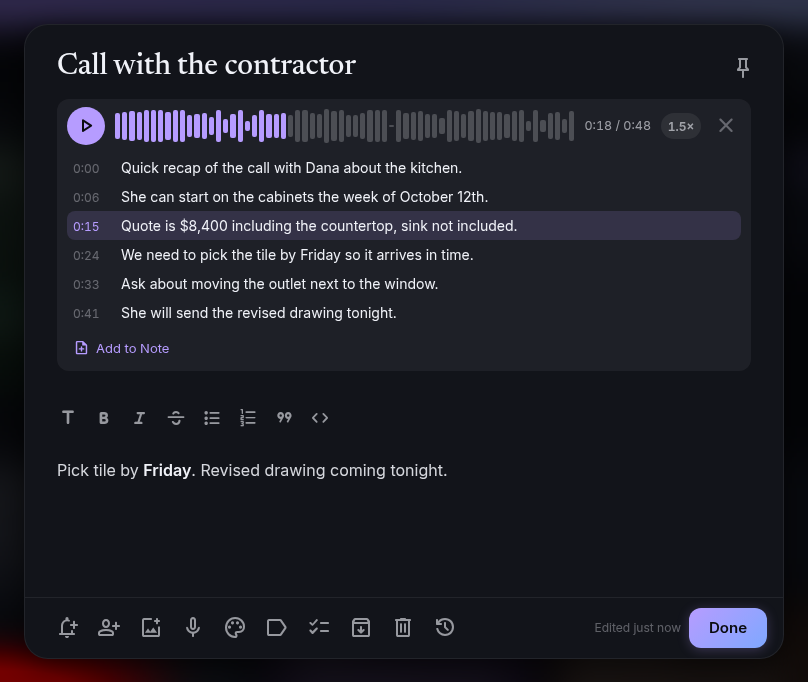
Each voice note shows a waveform with its length.
- Tap or drag the waveform to move to any point. With the keyboard, focus it and use the arrow keys (5 seconds, or 30 with Shift).
- The speed button steps through 1×, 1.25×, 1.5×, and 2×. The speed is remembered on each device.
- Picking up where you left off: a voice note you stopped partway through starts from the same spot next time, on that device.
Voice notes sync to your other devices like images do, and in Android local mode they stay on the phone until you connect to a server.
When the upload fails
A recording whose upload doesn't go through (no signal, the server restarting) is kept on the device and shown on its note as waiting to upload, with Retry. It goes up on its own when the connection is back, when the app comes forward, or within a minute, and is then transcribed as usual. A note with a recording waiting isn't treated as empty, so it won't be cleaned up.
Audio files
Audio you already have becomes a voice note too:
- In the editor: Add an audio file instead in the recorder, Add Audio File in a phone's Add sheet, or drop or paste audio files onto the note.
- From another app: share a recording from a voice recorder, a chat, or a file manager, and pick NoteTrace. In the Android app and in the installed web app on Android it opens a new note with the recording on it.
- From Google Keep: voice recordings in a Takeout export are imported with their notes. See Import and export.
MP3, M4A, WAV, Ogg, Opus, WebM, AAC, and FLAC play as they are. Formats browsers can't play, such as Keep's 3GP and AMR recordings, are converted to M4A by the server when you add them. That needs a connected server with audio support (the NoteTrace Docker image includes it); in Android local mode those files can't be added.
Transcripts
With Transcribe Voice Notes on (Settings, Trace; on by default), each new voice note is transcribed. The transcript shows under the recording and is included in search. Add to Note puts it into the note: a paragraph on a text note, or one item per line on a checklist. A voice note that wasn't transcribed has a Transcribe button.
When the provider gives times, the transcript is a list of timestamped lines. Tap a line to play from there; the line that's playing is highlighted. Long transcripts show a few lines at a time, with Show all to see the rest.
| Provider | Transcription | Timestamps |
|---|---|---|
| OpenAI | gpt-4o-mini-transcribe by default |
With whisper-1 set as the Transcription Model (the gpt-4o models return text only) |
| Gemini | Your chosen Gemini model | Yes |
| OpenAI-compatible (Speaches, LocalAI, and other Whisper servers) | whisper-1 by default |
Yes, when the server supports verbose_json |
| Claude | No; Claude can't transcribe audio |
Long recordings
Transcription services limit how much audio one request can carry (25 MB for OpenAI, about 13 MB for Gemini). A longer recording is split into pieces, each piece is transcribed, and the transcripts are joined with their timestamps lined up. The server does the splitting when you're connected to one; the Android app splits its own recordings on the phone in local mode.
When Trace is set by environment variables, the server transcribes and splits voice notes itself. See Where the requests go.
Summaries
A long recording is the one you don't want to read back. Summarize on a voice note asks Trace for a handful of bullet points covering what was said: the facts, decisions, names, dates, and anything you said you would do.
- One press is enough. On a recording that hasn't been transcribed yet, Summarize transcribes it first and then summarizes it.
- The summary reads first. It sits under the player, with the transcript folded behind Show Transcript, so the recording stays legible. Add to Note writes the summary into the note; the transcript is still one press away.
- Redo Summary asks again, for example after changing provider or model.
- Short recordings don't offer it, since a summary of a sentence is the sentence. The button appears on recordings from about half a minute, and on any transcript long enough to be worth compressing. This is separate from the 10 minute rule below, which is only about summarizing without being asked.
- The summary is saved on the recording, so it syncs to your other devices and stays out of the note's text until you put it there.
With Summarize Long Recordings on (Settings, Trace; off by default), anything over 10 minutes is summarized as soon as it's transcribed, with no press at all.
How it's stored
A voice note is an audio attachment on the note, with its length, a small waveform, its transcript, the transcript's timestamps, and Trace's summary when it has one. See Images and voice notes.